Before the festival
Before attending the Sedona Lantern Festival, my goal was to engage deeply with a culture distinct from my own, particularly through a spiritual lens rooted in Korean and Taoist traditions. I anticipated this experience would expand my understanding of multicultural expressions of healing and allow me to reflect on cultural humility within clinical psychology.
I expect the Sedona Lantern Festival to offer an experience of peace and global connection. I am particularly drawn to the ritual of floating lanterns, which I understood to be rooted in Korean Buddhist and Taoist practices of honoring ancestors and releasing burdens. I am excited and slightly anxious, because I am not sure how I, as an outsider, will fit into the event’s communal atmosphere. My goal is to observe with humility and engage as a respectful participant rather than a passive observer.
At the Sedona Lantern Festival
The Sedona Lantern Festival was a rich cultural and spiritual experience that merged Korean traditions with a diverse, global atmosphere. My husband and I arrived later than planned after a long drive, much of it on an eleven-mile dirt road through the red rock desert. About fifteen minutes before reaching the retreat, we began to see rows of what looked like international flags along the roadside, signaling that we were approaching a place of global unity and peace. Passing through the grand gates of the Sedona Mago Center felt like entering a space intentionally designed for reflection and connection.
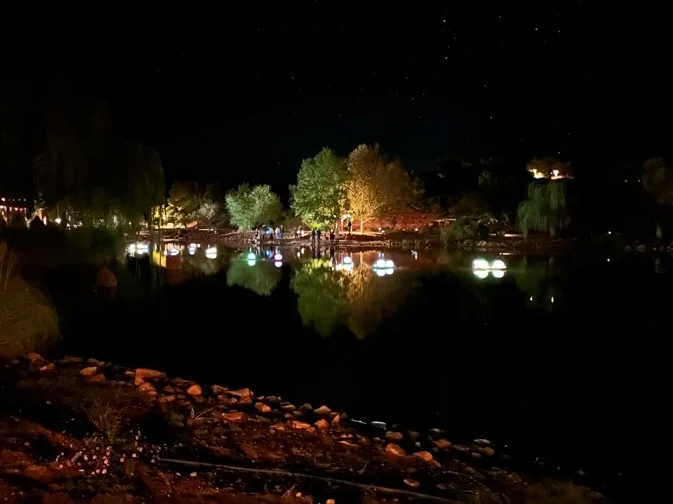
The property itself sits on nearly two hundred acres surrounded by the natural beauty of Sedona. I learned that the word “Mago” means the unconditional love and spirit of Mother Earth, a fitting name for a sanctuary dedicated to peace and healing. The center includes meditation gardens, a labyrinth representing the winding path of life, and the Healing Lake, a calm body of water where the lantern ceremony later took place. One of my favorite places on the grounds was the Chun Hwa Dae Gazebo, located on a hilltop and symbolizing “Heavenly Transformation.” Its open roof represents the crown chakra receiving cosmic energy, a powerful image for spiritual renewal.
Although I missed the chakra reading and shoulder massage offered earlier in the wellness fair, a woman traveling alone from Flagstaff told me her session was deeply grounding and restorative. I felt a twinge of disappointment knowing I had missed that part of the experience, but I also appreciated hearing about how it had affected another participant. It reminded me that cultural immersion is not only about what we personally experience but also about listening to and valuing the experiences of others.
Sedona Mago’s history further enriched the meaning of the evening. Founded in 1997 by Ilchi Lee, a Korean meditation teacher and author, the center’s mission is to help people reconnect with their true selves through Tao principles of balance and mindfulness. Everything on the property, from the quiet casitas free of televisions to the healthy pescatarian meals, reflects this commitment to simplicity and intentional living.
This year’s event was especially meaningful because the Sedona Mago Center is celebrating its 27th year of existence, and this was the 7th Annual World Peace and Lantern Festival. The number seven has personal significance for me, representing growth and spiritual alignment. Attending during my own seventh wedding anniversary year added another layer of meaning, as if the event itself was symbolically honoring cycles of renewal and partnership in my own life.
As someone who adores Korean dramas, I already knew the phrase “Annyeonghaseyo” (안녕하세요), which means “Are you well? Are you at peace?” I often watch K-Dramas in their original language with subtitles, finding the sound of Korean speech both calming and expressive. Hearing some of the staff and attendees greet one another in Korean felt unexpectedly familiar and comforting, deepening my sense of connection to the culture.
I have to share that as the evening unfolded, I found myself navigating mixed emotions. While much of the ceremony felt sacred and grounding, I also noticed moments when others did not seem to honor the cultural or spiritual requests of the facilitators. Some attendees took photos and videos during times we were asked to refrain, and others spoke loudly during the silent walk to the Healing Lake. I felt frustrated and even angry at what I perceived as a lack of respect for the tradition and the space. I had to consciously remind myself to return to my own center, to breathe, and to let go of what I could not control. This experience became an unexpected lesson in mindfulness. I was forced to recognize that my reactions were mine to manage and that true respect for culture also includes responding with compassion and restraint, even when others do not.
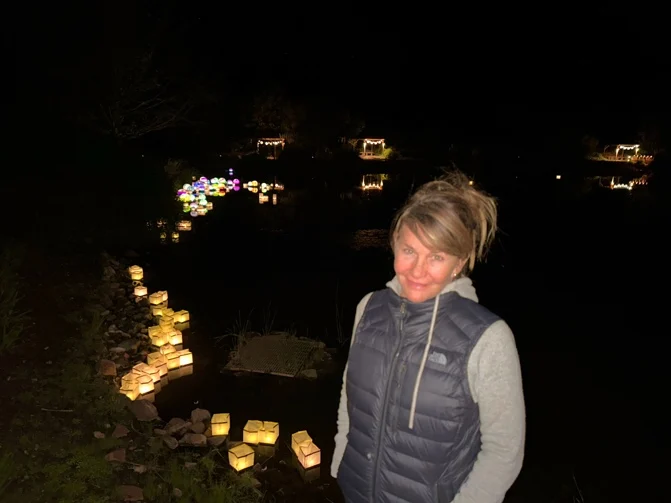
This annual festival draws on the Korean floating lantern tradition, known as tteunbul, which honors ancestors and symbolizes renewal and peace. From a psychological perspective, the ceremony illustrated how collective ritual can create both personal and shared healing. When my husband and I released our lantern, we noticed that the box we held was covered in the wishes and prayers of others who had come before us. That realization felt humbling. To add our hopes to those of so many people from different cultures and backgrounds was both an honor and a privilege. As the lanterns of varying shapes and sizes began to drift across the Healing Lake, guided by the soft glow of candlelight, a woman’s voice recited the words of Ilchi Lee about unity, love, and peace. The moment felt sacred, like an unspoken recognition that all of us, regardless of origin or language, share the same desire for connection and healing.
Even now, as I reflect on the experience, I feel emotional. Something about the evening and bonding with this specific culture has stayed with me. If I close my eyes, I can clearly hear the woman’s voice and feel the stillness of the water. I can feel the collective breath of hundreds of participants, and the sense that we were part of something much larger than ourselves. This experience expanded my understanding of how community, intention, and symbolic action can restore both individual and collective balance.
I left the ceremony with a deep sense of gratitude and reflection. Eastern traditions have offered Westerners an invaluable gift: the awareness to look inward before reaching outward. The Sedona Lantern Festival reminded me that self-awareness and collective healing are deeply connected; when we cultivate peace within, we strengthen our ability to send that peace into the world. Watching hundreds of lanterns drift across the Healing Lake, I realized that this act of shared intention was more than ritual, it was a living expression of unity. The lights symbolized how individual insight and collective compassion can coexist, each illuminating the other.
Rooted in the Korean tteunbul tradition, the floating lanterns represented renewal, remembrance, and hope; values that transcend culture yet remain deeply tied to it. This ancient practice offered a tangible reminder that healing often begins with illumination: by tending to our own inner stillness, we become more capable of radiating empathy and peace outward. When we each bring forward even a small light of awareness, the collective glow can transform not only ourselves, but the world we share.
References
Comas-Díaz, L. (2016). Multicultural care: A clinician’s guide to cultural competence. American Psychological Association.
Cultural Heritage Administration & Yeondeunghoe Safeguarding Association, Republic of Korea. (n.d.). Yeondeunghoe: Lantern lighting festival in the Republic of Korea [UNESCO Intangible Cultural Heritage]. Intangible Cultural Heritage. https://ich.unesco.org/en/RL/yeondeunghoe-lantern-lighting-festival-in-the-republic-of-korea-00882
Sedona Mago Center for Well-being and Retreat. (2025). Sedona Lantern Festival: Unite for a world in need of love. https://sedonamagoretreat.org/programs/annual-events/sedona-lantern-festival/