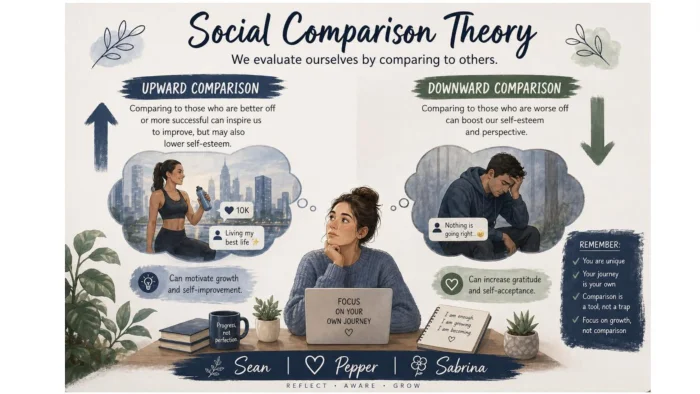
The idea that we learn about our own abilities and attitudes by comparing ourselves to other people. People socially compare when there is no objective standard to measure themselves against and when they are uncertain about themselves in a particular area.
Looking up, looking down
Upward comparison means comparing ourselves with someone we perceive as more skilled in an area that matters to us. It can give us something to work toward. It can also make it easier to overlook how far we’ve come.
Downward comparison means looking at someone who is having more difficulty in that same area. It can put our own struggles in perspective.
Two examples
Upward comparison: Sabrina is a behavior specialist- when her clients are in crisis and she can’t regulate them and she thinks to herself that she is not good enough and questions her abilities and if she ever learned the skills. She is working toward a better future version of herself.
Downward comparison: There was a guy feeling depressed and super sorry for himself so much that he slid down the wall and he was just giving up and crying because he didn’t have any shoes. A guy tapped him on the shoulder and when he looked over at the guy, he didn’t have any feet.
When the comparison is online
Seeing other people’s lives online can intensify insecurity, self-doubt, or the feeling that everyone else is doing better. Stepping away from the feed, spending time with people we care about, or unfollowing accounts that reliably leave us feeling worse can make room for a different perspective.